
What Makes a Man “Masculine”—And Why We Just Can’t Quit Asking
An illustrated conversation between Susan Bordo and David Masciotra about the frustrating resilience/recurrence of the “real man” debate



Susan:
I thought the “real man” fetish was a Republican thing.
Sure, the issue of whether a candidate is “manly” enough has always been there, subtly or overtly. We’ve had cowboys in denim and working class heroes with shirts rolled up from both parties announcing that they mean business on magazine covers.


Those codes may have worked on a subconscious level. But it wasn’t until the 2016 GOP primaries that the manliness issue got thrown right in our faces, complete with cringeworthy penile innuendo.
“He is taller than me, he’s like 6’ 2”, which is why I don’t understand why his hands are the size of someone who is 5’ 2”,” Marco Rubio joked about Trump. “Have you seen his hands? And you know what they say about men with small hands -- “ [The crowd erupts with laughter]
“ -- You can’t trust them,”
It was a prepared set-up that a man with a sturdier ego would have let go. But, as Grayson Carter has said, “Like so many bullies, Trump has skin of gossamer.” At a rally, Trump mentioned “little Marco’s” comment, and bragged “Those hands can hit a golf ball 285 yards.” And at the Republican debate, Trump referred to the small hands insult again. “Nobody has ever hit my hands. I have never heard of this.” [Which was false] Then, he held his hands up to the audience: “Look at those hands. Are they small hands? And he referred to my hands -- if they are small, something else must be small.”
“I guarantee you there is no problem,” Trump said, and with a serious face!: “I guarantee you.”
Wince. GAG. I don’t want to think about it.
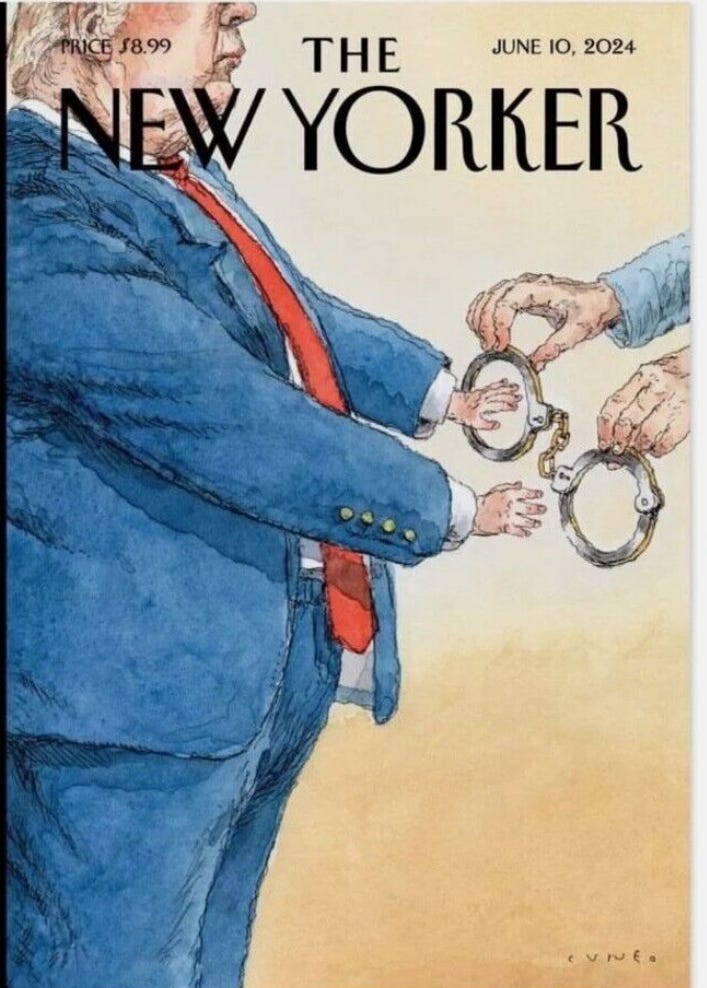
Trump has always and transparently been obsessed with the size of his stuff—and apparently oblivious to the psychological underpinnings clear to everyone else. The size of his buildings were always surrogates for his manhood, and when a building isn’t involved, a pool will do.


I was surprised that no commentators made the obvious connections and jokes about the pool like those that were made when Rubio sneered at Trump’s small hands. I guess that they all were too into the “Trump is losing it” narrative to say anything except how deranged that chart was.
In general, too, we seem to be taking the whole “manhood” thing more seriously nowadays than we did before Trump demonstrated that he could win an election—in 2024–by blatantly appealing to the wounded masculinity of young men. So now, even the Democrats are picking up the challenge to show that they are “real men.” Some of them are going a traditional route and others define it differently.
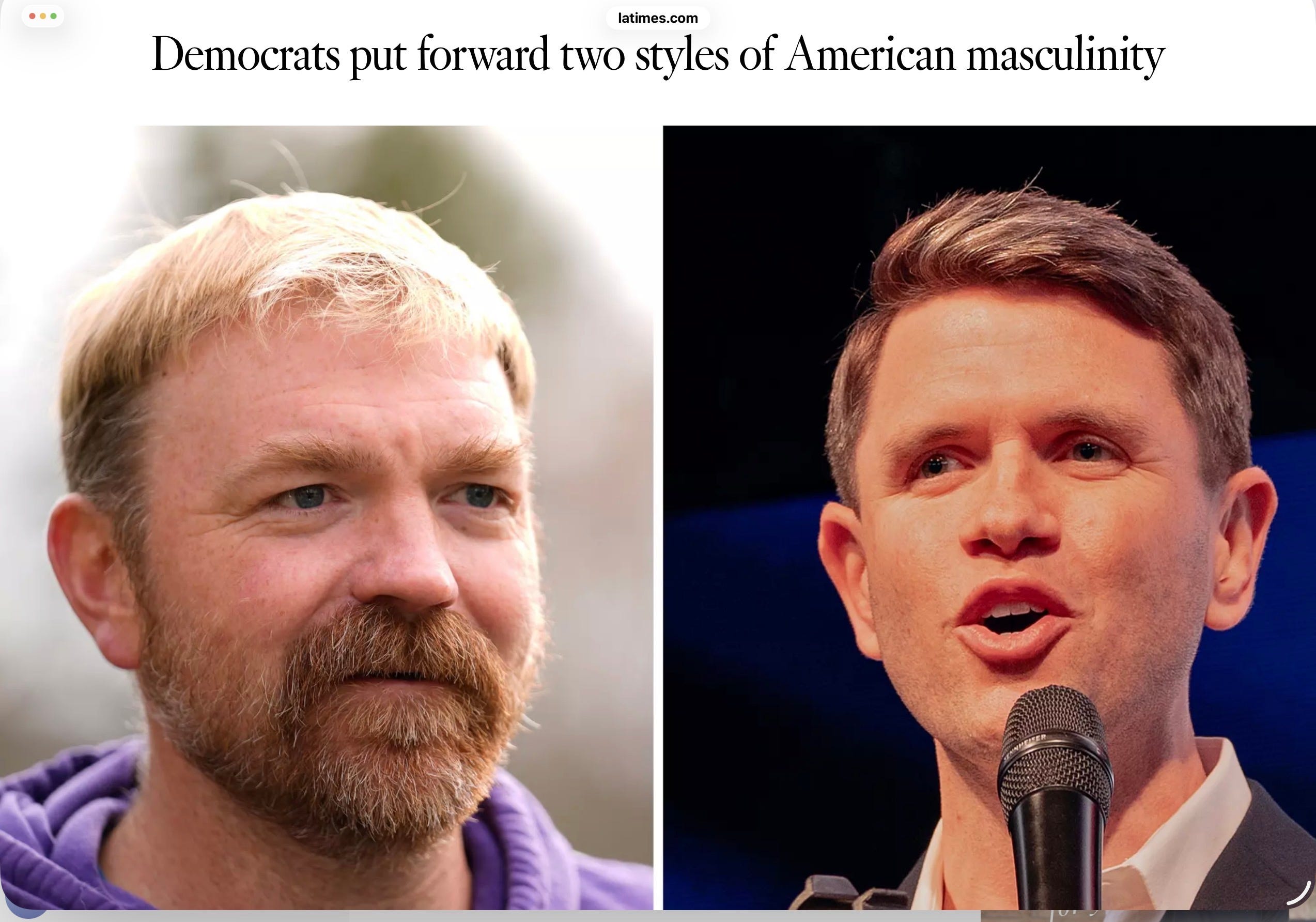
But whatever “style” of masculinity they project, they all seem to rise to the bait rather than laughing down the “real man” discourse.
I thought the most appropriate response when Ken Paxton “dissed” James Talarico as “too low-T for Texas” and Ted Cruz told Sean Hannity, “I gotta say, if you were making a list of 1,000 adjectives to describe this guy, ‘masculine’ would not be one of them,” came from the L.A.Times journalist: “Is that all they’ve got?” I imagine that’s the way Barack Obama might have responded, with accompanying facial expressions. “Are these people really serious?” he might have said, and then made a joke more clever than I can conjure.
But no, Talerico took up the challenge:
“There’s been a lot of talk in this race about what it means to be a real man,” Talarico told MS NOW’s Jen Psaki. “A man takes responsibility. A man upholds his commitments to his family and his neighbors. A man does what’s right, even when no one is watching.” Then he shared an anecdote about how his father shaped his idea of masculinity: “Every Saturday morning, Mark Talarico would mow our lawn, whether it was rain or shine, whether he wanted to or not. And then, without anyone asking him to, he would go next door and mow our neighbor’s lawn, because our neighbor was elderly, she was a widow. And my dad never talked about it, he just did it, because that’s what a man does.”
“Real men serve others, weak men serve themselves,” Talarico said. “I welcome this debate about what it means to be a man, and I don’t think Ken Paxton or Ted Cruz are in a position to tell anybody what a real man is,” he added.
He’s not the only Democrat who’s playing to the “what does it mean to be a real man” issue. My beloved governor, who I hope will run for president, is going there too:
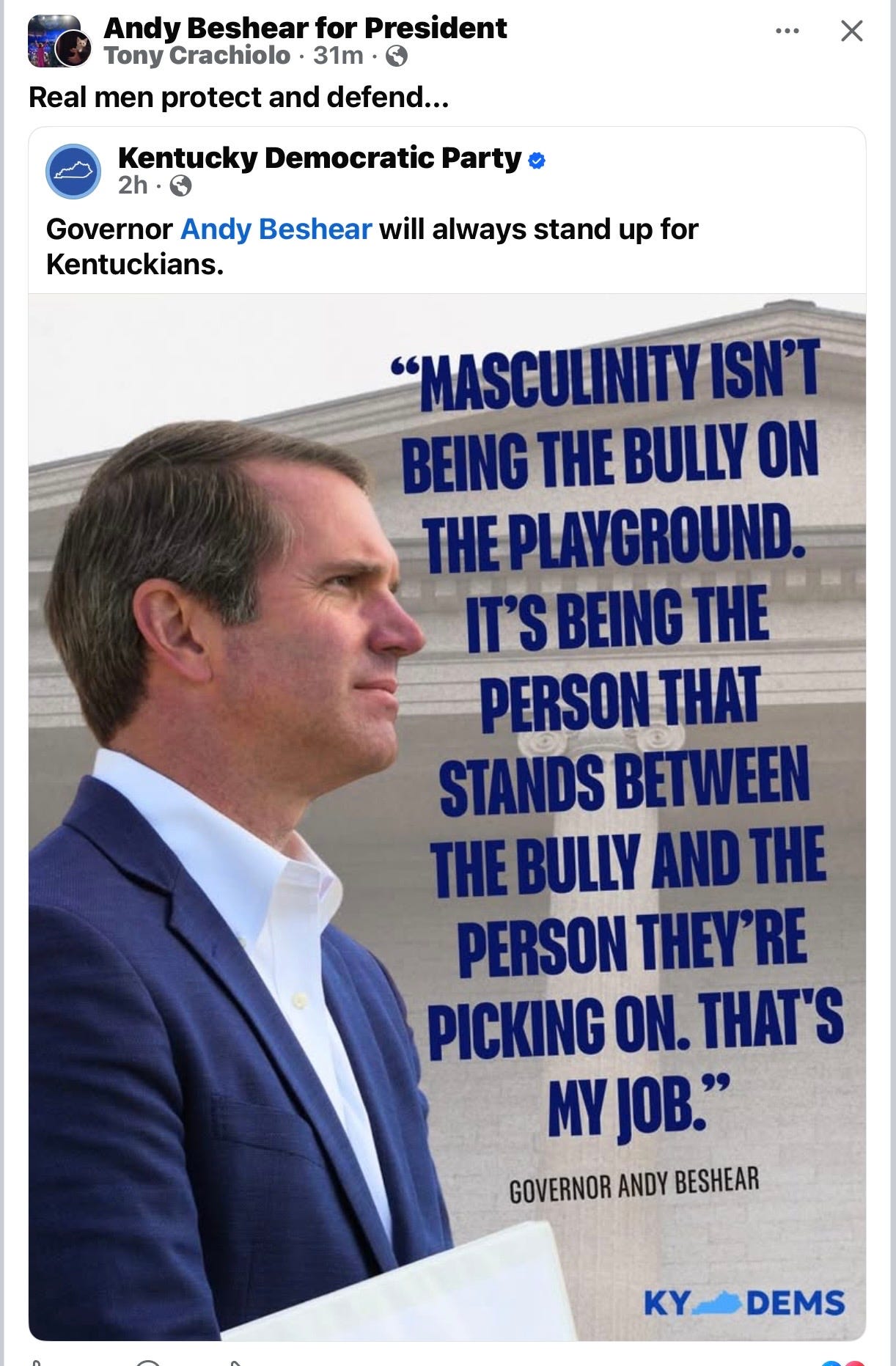
“I welcome this debate about what it means to be a man”
Just to be clear: I love Andy Beshear and I think he’d make a great POTUS. It’s the “masculinity” frame that I’m taking on here, not the man himself.
If this is what it takes to win nowadays, I guess the politicians and their managers know better than I. But—as with many other developments—it makes me wonder what century we’re living in, and where women fit into the picture other than as those in need of being defended—by protector-men against bully-men.
It also feels like a capitulation, once again, to the retrograde terms that have been set by the GOP. “Stand up and show the world the size of your hands!” They still bellow. And the answer seems to be either that of a Graham Platner, who proudly will do just that, or that of a Talerico, who says “real men” mow their neighbor’s lawns.
What do you think, David?
David:
What you are observing and describing, with characteristic verve and insight, is yet another reemergence of an old god. Just as we’ve seen the recrudescence of the old gods of inherently authoritarian forms of bigotry - xenophobia on the right, antisemitism on the left - we are also witnessing the return of the frail old god of the “real man,” who upon any inspection, is a hollow man.
Of course, discussing who mows the lawn and whose hands leave the largest print in the mortar indicates how American politics is about anything other than politics. There is so little interest, savvy, or attention span for public policy that elections resemble personality contests for prom king.
Even within our increasingly imbecilic framework, however, it becomes obvious how much our discourse remains chauvinistically gendered. In our rapidly spinning news cycle, 2024 feels like ancient history, but recall how the entire mainstream commentariat denounced Kamala Harris for her failure to offer “specific” policy proposals or discuss “working class economics.” It was the height of absurdity, given that all Kamala Harris did during her ten weeks on trail was emphasize economics and describe her plans for health care, housing, and the cost of living. Meanwhile, Donald Trump babbled incoherently about the stolen election of 2020, how Haitians were “eating the cats and dogs,” and his prowess in everything from golf to public communication.
Leadership is gendered masculine. As a consequence, the substance of leadership - in this case, policy expertise and command - is masculine. We can say the same for what has become the most romanticized notion in US discourse, that of the “working class.” “Working class” means a white man in a hard hat, swinging a hammer or working on an oyster farm. It certainly doesn’t mean a woman of color, who even if part of a demographic that is disproportionately poor and working class, is assumed to be part of a “feminist elite”; an HR scold.
Susan:
That gendered (and at the same time, racialized) definition of “the working class” has got me steamed ever since Bernie Sanders sneered at Planned Parenthood as an “establishment” institution. I’ve hammered away at this for a long time, but here I’ll let Stacey Abrams and Gretchen Whitmer speak for me:1
Stacey, in her 2022 run for governor, was constantly confronted by self-identified “progressive” men who, taking a baby-step beyond 2016 Bernie, conceded that abortion is an “issue” but one that “nowhere reaches” the importance of “working class issues” like the price of food, gas, or housing.
Excuse me honey, but are these “working class” people living in an all-male commune that’s never seen a diaper or driven a child to the emergency room of the hospital? And what about the single moms cleaning houses for a living who discover they are pregnant in the wrong state? “This is not a reductive issue,” Stacey argued, “You can’t divorce being forced to carry an unwanted pregnancy from the economic realities of having a child.”
Gretchen: “The most important, profound decision a person will make, especially a woman, or family, is whether and when to bear a child…How can women get into the workforce if they cannot make their own decisions about whether or when to bear a child or access health care?”
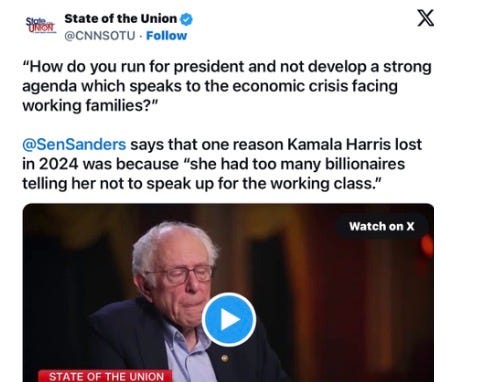
Yet the polls, the commentators, and the male campaigners still tack reproductive equality onto the list as special “women’s” or “family” issues separate from those “working class issues” that Bernie was still insisting—in 2024, in numerous interviews—that Kamala Harris ignored:
David:
One of the unfortunate lessons that we’ve all learned, with much pain, over the past ten years is that any issue that pertains mainly to a group that is not white, Christian, heterosexual, and male is little more than “identity politics,” except, of course, “Free Palestine,” which somehow implicates the entire planet. So, women having the ability to control their own bodies and medical care is “identity politics.” Similarly, the vicious assault on the human rights of Latino immigrants is some kind of “woke” fixation, as is the assault on Black political power and LGBTQ+ acceptance and rights. Unfortunately, there is a horseshoe consensus on this point between the nationalistic right and the progressive left. While the right shows outright contempt for women and racial and sexual minorities, the progressive left argues that their stories, issues, and crises are little more than “distractions” from the great “working class” revolution.
Finally, that brings us to “authenticity,” one of the most foolish and destructive concepts of American life, as it has come to simply mean lack of refinement and manners. Dumbing and defining the concept down leads to the popular perception that Donald Trump is “authentic,” but it is also indicative of the unspoken assumption that authenticity is masculinity. This is true even in Democratic politics. Hillary Clinton and Kamala Harris were inauthentic, but Joe Biden, with his up from Scranton middle class image, was the real deal.
One of the more shocking developments of the past few years is the efficacy of misogyny as a political and cultural recruitment tool.
You refer to the attitudes of young men, and that is a good place to think about the reemergence of the old masculine god. Combining anti-intellectualism with crudity, sexism, and homophobic and transphobic bigotry, much of American culture is now in the thrall of the idea that we can solve our sociopolitical and cultural problems with the transformation of politics into a professional wrestling program.
Graham Platner is exhibit A. Listen to one of his speeches with your eyes closed, and you will think that you are running a recording of an AI creation of Hulk Hogan speaking before the main event at Wrestlemania after reading The International Jew.
Susan:
Yes!! That man gave me the creeps way before the tattoo or sordid texts came out. The media was salivating over his “authenticity” (forgetting, apparently, that they had once praised Trump for that quality) but I saw the kind of guy who dominated the classroom and the political podium in the sixties. He was so obviously in love with his own presentation of self, and so artfully packaged as a “working class hero.”
But you know, the writing was on that wall as soon as the “progressive” Democrats and young wannabes like David Hogg started trashing the old guard for not being “fighters.” Depressed and anxious Democrats jumped on that, because they so craved someone to bash the GOP. But from the beginning, the rhetoric of “FIGHT” was loaded with ageism—the so-called establishment” (which still contains quite a few highly effective public servants) pictured as entirely composed of frail, doddering “dead wood”—and sexism, insofar as women have been raised to serve rather than aggressively “lean in” with raised fist and the rolled-up sleeves. If they don’t obey that rule, they get scorched—unless, of course, they are surrogate daughters to a working class hero.


David:
When you say that Platner gave you the “creeps,” I laugh because I had the same initial reaction. I wonder if, perhaps due to people socializing less - Putnam’s “Bowling Alone”2 dynamic - and interacting with the world through screens if they are unable to detect what should strike them as obvious, creepy behavior. Platner is the guy that you know is about to lose it. So, you stay away. Mamdani, with the cheesy smile and attempts at charm, is the guy making lofty promises who won’t leave women alone in the nightclub.
The larger point about traditional notions of masculinity gets dicey, though, because “real men,” according to everyone from Ted Cruz to Talarico, “take responsibility.” Platner takes responsibility for nothing - not his enlistment and reenlistment in the military, not his previous votes for Susan Collins, who he claims “sent him to Iraq” as if there were a draft, not his abusive behavior of ex-girlfriends, not his infidelity, not his declaration that he likes to masturbate in Port-a-Potties (he’s not a dandy who waits for the comfort of his bedroom), and certainly not his Nazi tattoo. Instead of accepting responsibility for his own actions, Platner creates a victimhood complex. He speaks in maudlin terms about his “journey,” blaming the “powers that be” and “establishment” for his own decision to enlist in the military multiple times, and to return to Afghanistan as a Blackwater employee. When the press began reporting on his offensive remarks and abusive behavior, he claimed that it was the “establishment” attempting to prevent his “revolutionary” campaign.
Platner’s deflections mirror the mainstream media’s obsession with the so-called “crisis” facing boys and young men. Studies show that boys and young men are lonelier than women, likelier to engage in self-destructive behavior, and academically far behind. Interestingly enough, it is only heterosexual men. Gay men actually outperform women in all academic and professional categories.
Commentators, left and right, have tried to explain the problem by assigning blame on the education system, the political system, and/or pop culture. In other words, anything but the (straight) men themselves.
The data is overwhelming, though, that many of the traits that our culture wants to trumpet as essential to “real manhood” are destructive, namely a stoic posture, quick to anger, that makes open, honest, and emotional communication difficult. Masculinity, in this iteration, becomes a trap. The insular worldview and behavior explains why young men struggle to make friends, and also why they cannot engage fully with the world. Studies show that the vast majority of men refuse to listen to music by women musicians, reads books by women authors, watch films by or about women, or even watch women’s sports. It is sexist, but also quite stupid to go through life shutting off the voices of over half the world.
If only there were a phrase for a set of characteristics that sabotages one’s own success and demonstrates indifference to the feelings of others, while also blaming other people for their problems. “Toxic masculinity” will probably never catch on, right?
Susan:
It caught on and became a joke at virtually the same time. (There they go again, busting our balls with feminist jargon…) Actually, though, I’ve never liked that phrase myself, and agree with Pete Buttigieg that it’s as repressive in its own way as the pressure to be a “manly” man:
“Nobody wants to feel like they’ve got to look over their shoulder all the time. I grew up in a time when as a man, you were looking over your shoulder to make sure that you were being masculine enough. And of course, that’s 10 times more if you happen to be gay. Then you go one turning of the wheel or one generation forward, and I think a lot of young men felt like they were looking over their shoulder for fear of being censured for somehow being toxic or being too masculine or doing or saying something wrong.”
Why is it necessary, though, to counter definitions of masculinity that are “toxic” with kinder, gentler alternatives? Why do we have to put a straight-jacket (pun intended) of any kind on masculinity? Academics used to insist on an “s” on the end of that word, to account for the actual multiplicity of cultural versions, and late-night comedians made fun of the discourse about what “real men” eat.
The sad, hard fact seems to be that even as rigid categories of sexuality and race are being deconstructed and replaced—not just in academic theory, but in young people’s everyday choices, styling, coupling—by blurrier identities, we just can’t quit the duality of gender.
David:
I was being facetious, of course, about “toxic masculinity.” Think of the trauma that conservative men claim from the occasional utterance of the phrase or Hillary Clinton’s “deplorables” remark, which is treated like it was the 9/11 attack. Not exactly the picture of strength….
But, yes, exactly. One of the tragedies of the current cultural decline is that as should be moving away from strict and rigid categories, many people are rushing toward them. “Masculinity” can describe everything and nothing. It is empty. Perhaps I’m strange, but I’ve not thought about “masculinity” since I was a teenager. I’m just living my life. People should behave as themselves, following their own interests and pursuing their own passions, with no regard for its “masculinity” or “femininity.” Masculine? Feminine? Who cares?
But think also about what we elide and excise with this narrow, “masculine” focus. Josh Turek, a paralympic gold medalist, is an exciting candidate with a great shot to become a US Senator in Iowa. The media and progressives ignore him. I suspect that his disability removes him from the “real man” conversation, just as ageism became a major part of the Platner versus Mills race. If we elevate masculine virility to a primary virtue, ageism and ableism become almost automatic.
In reality, though, those who claim that masculinity is about “courage” and “strength” are missing the big picture. A transgender teenager trying to exist in a small, Midwestern town, a woman fighting for her rights against an increasingly hostile culture, and a person in a wheelchair working doubly hard to build a wonderful, happy, and productive life demonstrate more strength and courage than the supposed “real men” of the manosphere could ever imagine.
The entire conversation elevates the man to the role of authority, while displacing women, and increasingly, women of color and LGBTQ+ people - operating under the assumption that “might makes right”. There’s a word for that too.
Maybe “patriarchy”?
David Masciotra is the author of six books, including I Am Somebody: Why Jesse Jackson Matters and Exurbia Now: The Battleground of American Democracy. He is a contributing writer with the Washington Monthly, and his Substack is Absurdia Now. He teaches at Indiana University Northwest and the University of St. Francis.
These quotations taken from
Closing the Gender Gap on Abortion

This is the week 10 edition of BordoLines’ “Election Watch.” I hope you’ll consider subscribing—and sharing—and “liking”!!
Political scientist, Robert Putnam, wrote Bowling Alone: The Collapse and Revival of American Community, a prescient book that documents and describes the decline of social, communal, and recreational life in the United States. Needless to say, with the smart phone and social media, the problem has only grown worse since publication.
 | A guest post by
|