
Three Bears
I loved “The Bear” from first to last season. All the characters are memorable & I could write about any of them with delight. Here it’s Sydney, Carmy, & Richie {ALERT: THIS STACK IS ONE BIG SPOILER}

Prologue
I was looking forward to the final season of “The Bear.”
After two episodes I turned it off and went to bed.
It was as though the writers had decided to dump every nightmare they could imagine on these already-battered human beings. Relentless rain clogging drains with dirty cigarette butts. Bursting pipes. Reservation system fucked up. Those insistent, taunting zeros on “The Computer”s timer. A jittery musical score fit for a disaster movie, anxious and relentless, like a hungry approaching shark. And it went on and on through two whole episodes.
Hard to take, especially since that thunderstorm—with its crushing, numbing, raining down of despair and the need to go on despite all indications that it’s hopeless—began to feel to me, whatever the writers did or didn’t intend, like a metaphor for our situation. Here in the shit-show that has been dumping on our country for some time, and seems never to end.
The next day I picked up on the season where I left off. I’d stuck with this show through the bog as well as the bliss, and I wasn’t going to abandon it now.
I’m glad I stuck with it.
Brief Meta-“Bear”
In life, people change. Even our stuckness takes different shapes over time. In most television series, the characters can be described in a couple of sentences that remain applicable from beginning to end. We ignore, may even enjoy the familiarity of the characters we identify with, cheer on, or love to hate as we get led, from season to season, by the contrivances and intricacies of “plot” and the enjoyment of dialogue. The fan groups devoted to “Succession” spent a lot of time taking sides for one or another of the siblings (Siobhan got the worse of it, almost as bad as if she were a real woman running for office) and the professional commentary was mostly a run-down of the sharpest, cleverest lines. Looking back now after “The Pitt” and “The Bear,” “Succession” seems aggressively clever, but bloodless and cold.
“The Bear” is anything but cold; it has heart from the first episode, and—with the possible exception of Claire (Molly Gordon) Carmy’s love interest, whose Madonna-like calm irritated some viewers—every character was loved, because so lovable. And when we saw their ferocity melt into sweetness our own hearts moved with them. There’s plenty of dialogue and incidents that made me laugh out loud and allowed the award shows to put the series in the category of “Comedy.” It never was except in the classic Shakespearean form in which things fall apart and chaos reigns and then they come together again in the end. There are also some quasi-cliffhanger moments, but not really. “Will the restaurant succeed or fail?” “Will Carmy overcome his emotional deficiencies and get back with Claire?” “What will happen when The Computer’s clock runs out?” Not exactly uncertainties that had us holding our breath from season to season.
In “The Bear” the seasons unfold around the characters, not the “plot”—or rather, the characters are the plot—and although there is a central figure, his arc isn’t the only one, or even the main one, that we are moved by. The title of the show itself is ambiguous (academics would say “polysemic’) Who or what does “The Bear” refer to? A family nickname (for Berzatto)? Seems that way sometimes, but workers and close acquaintances sometimes greet the entire staff with “Hello, Bears!” It also gets attached here and there to individual non-family members, like Claire-Bear. Then again, it isn’t clear in the show just who is actually in that family or where “family” itself ends. Biology doesn’t seem to have much to do with it.
Does “The Bear” as series title refer to the growling beast of grief, fear, guilt, and regret that every character wrestles with? The first season opens with a nightmare sequence of Carmy (Jeremy Allen White) facing down an actual bear—a metaphor for every feeling and fear Carmy is trying to tame with his perfect “plates.” The name of the restaurant, too, is “The Bear”—suggested by brother Mikey (Jon Bernthal) whose absence haunts the entire series from first to last season. But also, Carm bestows the title on Sydney (Ayo Edebiri) when he turns leadership of the restaurant over to her in the last episode of season four. “You’re The Bear” he tells her—and it’s both a definitive reassurance and a truth that he’s come to, finally, after seasons of morose, compulsive perfectionism that he forced others to adapt to.
Sydney
Episode 7 of Season 2: We see Sydney fiddling with a dish, and a bit of an interview with Coach “K” (Krzysewski) whose memoir Leading With Your Heart: Successful Strategies for Basketball, Business and Life” is given to Syd by her supportive dad (Robert Townsend) and that she carries around for months. Because I’m a compulsive researcher, I actually read a few pages of the book; it’s about how Coach K turned a losing team around by listening rather than talking at players, getting to know every one intimately, and above all, remembering that even if you’re the leader, you’re part of a team.
Not exactly a description of Carmen. In season five, Richie (Ebony Moss-Bacharach) coaches him as they smoke under a tarp in the pouring rain.
R: “You’re not, like, a great teammate.
C; “What the fuck does that mean?”
R: “You know, you’re always alone, you know?”
C: “That’s not even true. I’ve worked in kitchens my entire life.”
R: “Yeah, and you just shouted at everybody….That’s not collaborating; you know?….Doing something where you have to think about other people and other things, that would be good for you.”
C: (referring to an anecdote Sydney has told him about driving a truck for American Express and being told to always “turn right” to conserve gas for everyone)” “I should turn right.”
R: “I don’t know what the fuck that means. Just be a team player, you know? Be a fucking human being. Ask somebody how they’re doing. Tell them they’re nice. I don’t know.”
That’s Syd. She’s a brilliant chef, but takes time out to make a simple, luscious omelette (eggs, Boursin cheese, chives and crushed potato chips) for the heavily pregnant and exhausted Sugar (Abby Elliott). When Carm serves up his private shorthand as a substitute for actual communication, she doesn’t “yes, chef” but asks what he means, dude. A lot of the time she lets weirdness and bad behavior slide, not wanting to contribute to the chaos. (As viewers, we know what she’s really thinking by her expressive face.) When she’s on the brink of melting down with frustration, she goes outside to scream. (Carm: “Yeah, but that’s the thing. I, um, I would have chosen to scream at everyone else.” Right, chef.)
Sydney is complicated. The only child of a father who isn’t afraid to love her openly and lavishly, she’s taken aback by how ready-to-fight themselves and the world her new restaurant family is. But also—although the show never does a feminist preach—she’s Black and a girl, and uncomfortable with potentially dangerous conflict. She’s been raised, both by her father’s example and his need of her, to think about and care for other people. But like most women she’s never associated it with leadership—because our culture doesn’t. We depend on women to attend to others, but in subordinate positions. When it comes to picking “leaders” we favor the Big Talkers, not the empathic listeners. And we recoil from contenders who show uncertainty or doubt.
Unlearning old habits is the hardest thing, especially when they go against norms of “gendered” behavior. Even after Carm has made Sydney head chef it’s difficult for him to stop barking out the solutions to problems and addressing them without consulting Syd. And Sydney has to adapt to thinking of herself as “worthy” of running the restaurant.
As heartfelt as Carmen is being, there’s a whiff of “mansplaining” there. And my heart, as an older woman raising a daughter not much younger than Syd, aches over her genuine puzzlement at Carm’s confidence in her. “How can you say that?” And “Why?” She asks. It’s not an act. She’s read Coach K’s book but she doesn’t allow herself the hubris (as she sees it) to imagine that that it applies to her.
It’s taking the guys a while to get it too. Richie blatantly disobeys her order for him to cancel fifteen reservations for the overbooked, understocked evening service. But although Syd repeatedly says she’s going to kill him, she knows how important it is to nurture the self-esteem and joy he found during his time at Ever, where he discovered that he has a calling higher than creating the perfect plate—that of delivering happiness to others in acts of service. He’s found purpose in his own ease and ingenuity in making that happen for guests. And how can Syd, as leader, not want to have a member of her team be exactly like that?
It’s especially hard for a woman in a hiearchical profession to gain respect at the same time as her every instinct leans toward connection and empathy. And it’s hard to loosen that double-bind so long as the habits of “niceness” and accommodation to others are seen as antithetical to leadership.
One of the loveliest things about the final season of “The Bear” is that we see where the show stands—unequivocally—on that issue.
Carmy
By the time of my first viewing of the last episode of season four, I’d had more than enough of the series’ close-up on Carmy’s brooding, self-involved, solipsistic—and I’m sorry/not sorry, but very male—emotional deficiencies. My love for the show was persevering more because of the wonderful episodes centered on everyone else: “Forks” (in which Richie discovers his purpose—and, as it turns out, superpower—is making guests feel individually, exquisitely cared for); “Napkins” (Tina’s “backstory” of how, depressed and desperate after weeks looking for a new job she happens on the Original Beef—and the warmth of Mikey); “Ice Chips” (Sugar goes into labor, and having tried unsuccessfully to locate everyone else, calls her mother—and we see the psychological clutter and barriers that have grown between Natalie and Donna dissolved—for the moment at least—by the simplicity and absolute priority of Sugar’s needs and—to the amazement of both of them—Donna’s ability to actually take care of her daughter); “Worms”—my personal favorite— which takes Sydney into the South Side to have her hair done by cousin Chantelle (Danielle Deadwyler) and she cooks elevated Hamburger Helper for her niece TJ while trying to decide whether to take a new job or stay with “The Bear.” The conversation Syd and TJ have is absurd, believable, precious and priceless, and if you want full details and clips, I’ve got a stack for you.1
By the time he announces he’s leaving “The Bear,” Carmen had been getting on my nerves for a while. I had lost patience with his obsessive focus on the minutiae of each dish (Is that plate at just the right angle? Are those hand-shelled peas lined up correctly? Where should I put that sprig of parsley? Why don’t the hand-crafted bowls match each other exactly?) I was irritated by his long silences between sentences and his too-belated, inadequate apology to Claire-Bear. His relentless moroseness, which I had empathized with as connected to his “unresolved” anger, hurt, and guilt over (what he saw as) Mikey’s rejection and abandonment of him now seemed to me to be a little…extra. Get over yourself, dude.
I saw his inarticulate attempts to explain to Syd and Richie why he had decided to leave “The Bear” as self-indulgent and rationalizing. In my original stack on that episode, I wrote:
Maybe objectively speaking it’s the right decision. But looked at in another way, it’s more of the same. We’re meant to see Carm, this season, as going through some kind of process of “healing” and I’ll give Storer that if that’s what he wants to be the take-away. But what a self-indulgent, wasteful privilege it must be to feel justified to quit something you’ve spent years taking as seriously as it’s possible—and always with the benefit of other people’s care, patience, energy, dedication, and love—just because you can’t sustain the endorphin high you got when your ego was driving things? “It’s ok to not love it any more,” Sugar tells him, recalling on the telephone how excited and inspired he was when he first left Chicago to study in New York. Yeah, for sure. But is it ok to leave just because the thrill is gone? Just because you make some major mistakes and might need to change in order to make things work better? Take a leave of absence, man, and see the world. Or put Sydney and Richie in charge of the restaurant and train young chefs behind the scenes. Why is this an either/or between being the center of the universe and stepping away completely?2
In season five, though, after he sees how sad/mad everyone is when Syd “leaks”that he’s leaving, it’s as though he recognizes, perhaps for the first time, that he’s not a solitary atom bouncing from plate to plate, never finding solace in any of them, but a member of a family that is acutely affected by what he does. Worrying over the people he’s hurt, it’s touching how hard to tries to take Richie’s advice to “be a fucking human being” and how warmly the others respond. He has genuine conversations that are not centered on his own anguish, he offers specific help, he asks how people are doing. His tenderness—which has always been a part of his personality but usually in losing contest with his self-absorption—is blooming.
In season five, Carmen finally starts getting unstuck, and it prompted in me a rewatch of season four. I noticed a lot that I had missed or not given enough importance to: The fact that Carmy’s visit with Donna (Jamie Lee Curtis) genuinely cracks open his heart. The fact that he calls Pete (Chris Witaske) to alter the terms of partnership of “The Bear” immediately after he finally apologizes to Claire and realizes just how profoundly he fucked up with her. (How could I not have noticed the significance of this? I think I must have seen it, at the time, as just another one of his ever-shifting whims, like changing the menu every day.) His trip to the Frank Lloyd Wright building—a site I know well from my truncated time as a student at the University of Chicago; the building is located within sight of the dorm I lived in—during which he slows down and re-establishes connection with the singular beauty of shapes, forms, colors. Soon after, he will explain in a job interview at an architectural firm how colors and shapes and how they were transformed during cooking were what first fascinated him about food.
In one of the last scenes in the final episode he looks at a “not received” text he had sent to Mikey and then his eyes travel the the office wall that‘s covered with photographs of the dishes he’s made or inspired him. And I remembered that he’d texted one of those to Mikey. In the “Napkins” episode. Mikey shows it to Tina (Liza Colon-Zayas). “What the hell is that?” She asks. “I have no idea,” Mikey answers, and they both laugh. But Mikey goes on to kvell over his baby brother’s accomplishments
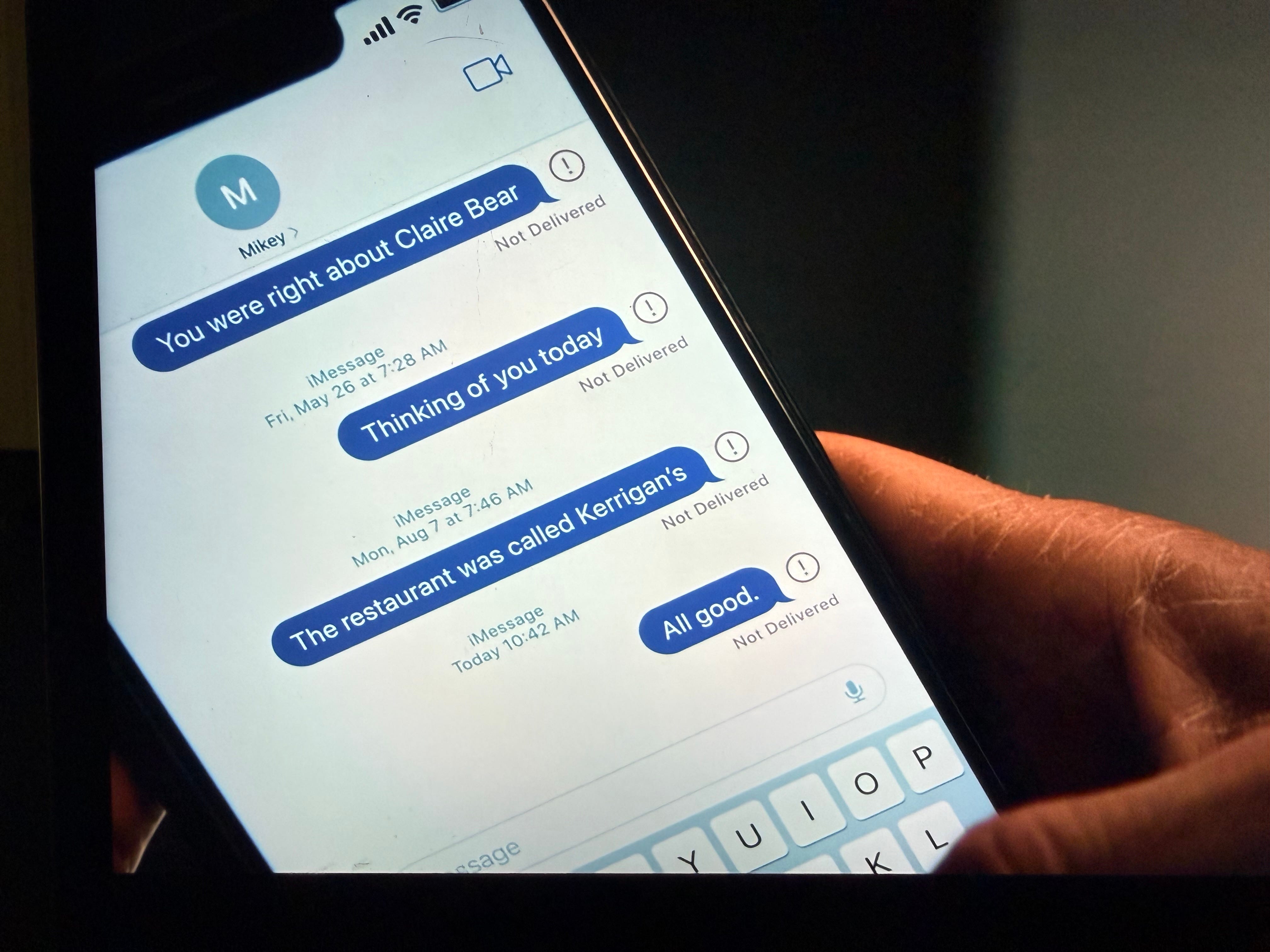
.
The wall of photos also reminded me of the many moments—they seemed merely like little biographical grace-notes at the time—when our direction is turned to Carmy’s drawings. Claire remembers seeing him draw in class when they were kids. Donna browses through Carmy’s notebooks, marveling at the intricacies of his sketches of the dishes he’s preparing. Chef Andrea Terry (Olivia Coleman), owner of “Ever,” catches him drawing and remarks how beautiful the sketch is.


Perhaps, had the family business and the demands of making a living not decided the path his creativity and love of beauty should follow, Carmen might have been an artist. Maybe he still will be. A cookbook, illustrated with his sketches? Watching the last scenes of Carmy in his office, I try to figure out what he’s thinking as he gazes at the wall of food-photos. It remains a mystery to me. But as Chef Terry tells Richie, it’s never too late to start again.
Richie
Kierkegaard’s “Fear and Trembling” was one of my favorite books when I was studying philosophy—and it called to me again, from a long-ago time in my life, during the final season of “The Bear.”
It was Richie who did it. All the characters in the show change and grow over the seasons, but none so profoundly as Richie. When we first meet him in season one, he’s as tightly wound as a human being can be. Sadder than he lets himself reveal to others—his marriage is over, his best friend has killed himself, and he’s seemingly going to be making beef sandwiches for the rest of his life—he’s always primed for a fight (and almost does kill someone.) He’s angry at Carmy for taking possession of his own little piece of turf—The Original Beef—and trying to turn it into a disciplined, elegant restaurant. It’s more existentially devastating, though, than resentment or jealousy. At least in “The Beef” he could turn his rough charm on for customers. What “purpose” can he have in an upscale, “fine dining” establishment?
Then Carmy sends him to stage at “Ever.” I’m tempted to—but won’t—go into detail illustrating the turnaround he experiences there, but instead let one brief conversation he has with maitre d’hotel Jessica (Sarah Ramos) stand for all. She has a complex and meticulous system of coding details about every guest, which she delivers to staff with the rapid fire of an auctioneer. How can she keep up with it, day after day, Richie asks her.
“Every night you make somebody’s day. That’s how I can do this.”
Obsessing about where to place the sprig of parsley purely for the sake of the “perfect plate” is not something Richie can put his heart and soul into (as Carm apparently can.) But planning a special night so those high-school teachers who have been saving up for years will feel like VIPs—that’s something Richie can respect. And is magnificently good at. Later, at “The Bear” he will organize an artificial snow shower for a young woman recovering from cancer who’s never experienced the comfort-magic of hot chocolate in winter. (Not incidentally, it will turn out that another guest, who’s been silently watching with delight—and relishing Syd’s scallop dish—was actually the “starman” who rates restaurants.)
Having found his “purpose”—in a talent he’d had all along—Richie isn’t going to give it up easily when “The Bear” is in trouble. No, he won’t—he can’t—cancel that reservation. The guy hasn’t seen his brother for fifteen years, and he’s flying in from Norway. Not enough food to cook for everyone? Fuck that, we’ll make it happen.
Relevance of Kierkegaard? (I’m going to leave out the talk about God, which is important to Kierkegaard but not to what I want to say about Richie.)
In “Fear and Trembling” he describes what he calls the “movement” from resignation—in which one becomes reconciled to what is lost or impossible to achieve—to faith. Resignation is painful but necessary to the movement to faith, because faith can only be faith if it is sustained about this flawed, sorrowful life rather than through imagining a lovely afterlife as reward or solace for suffering. But faith, at the same time, is also a kind of protest against what reason dictates is forever lost or impossible. The “knight of faith” has known despair and recognizes when the rational conclusion is that a situation is hopeless. And yet he refuses to believe it is hopeless. For those thinking like rational human beings, it’s an absurd stance to take. But the “knight of faith” embraces the absurdity of it and forges ahead anyway.
Think about this while listening to Richie’s pre-game speech to The Bears before their make-it-or-break-it night. He starts, as he has done in the past, with some ponderous philosophical “words of wisdom” that he’s culled from his readings. (Kierkegaard would call this remaining with “the universal” and he has little regard for it.) But then he stops and shifts gears:
You may find the triumphal music a bit much. I don’t know. I just love the guy. He’s “The Bear’s” knight of faith and he brings everyone else along with him.
Predictable as it was, my heart got what it wanted (and a nod to the ending of “Say Anything”?) when Jessica sits down next to him on that flight to Japan. Yes, Chef, thank you, that desert was satisfying. And even more delicious:
For all these episodes and more, see my stacks on the show. Just fill in “The Bear” on the search box of the BordoLines homepage and you’ll get links to all of them.
![Please Let The Women Write Season 5 of “The Bear” [Warning: Contains Spoilers and Feminism]](https://substackcdn.com/image/fetch/$s_!9Zfu!,w_140,h_140,c_fill,f_webp,q_auto:good,fl_progressive:steep,g_auto/https%3A%2F%2Fsubstack-post-media.s3.amazonaws.com%2Fpublic%2Fimages%2Fbd934856-9dda-4bdf-9215-f04306e49574_1343x742.jpeg)
I really appreciate this essay! I loved the breakdown and analysis of the characters. It occurred to me each of the characters you describe (and more!) inspire a tenderness in me. That cannot be said of my reaction to shows like Mad Men and The Sopranos, which I heartily enjoyed. I think what your piece conveys and underscores is the unrelenting humanity and love all the Bear characters have for each other. I felt some melancholy watching the last episodes, and not just because this was the last season. I have not been a part of a synchronized team effort under hardship (to my knowledge) in the way that these restaurant workers come together and then can celebrate. I missed out on being part of any sports teams while growing up. Yes, I've worked in groups, served on boards, collaborated on songwriting, but enduring wild ups and downs while maintaining connection, mentoring others, making public mistakes, learning to apologize, and so on....I could have used more of that in my life! Thank you for being a wonderful writer who can bring out this melancholy in me and make conscious longings I had not acknowledged. I will miss The Bear!!!
Wonderful essay, packed with your trademark blend of analysis and empathy and a tribute absolutely deserved by a show I first saw as an intriguing oddity but came to see as one of television’s greatest achievements. I have a Bear essay in me, but the demands of my new job may mean I don’t end up writing it. But I’ll give spoilers for it here. I hope you don’t mind that, and I also hope you’ll forgive my big wooden spoon full of my slightly different reaction, and (if you’ll forgive, also, the labored metaphor) a drizzle of the personal.
I found the music occasionally manipulative in a way I didn’t love, but that is typical of me, and ultimately a minor quibble. Carmy’s flaws and the focus on him didn’t bug me the way they did for you, but at this point in my life I find I’m more willing to occasionally accept the charge that my maleness sometimes affects my ability to empathize.
Thinking of it from a detached storytelling analytical position, I think I could make a case for Carmy being more of a catalyst and inciting incident than a character. In real life, of course, your reaction to him would be appropriate. In the context of the show, I think all the things about him that are hard to take are driving much of the drama and the character development of the characters that I find more moving and captivating. I can’t see the show— or the other characters— being as strong without his flaws.
It’s tempting to call Sydney the central character, but Richie is endlessly fascinating too, and by the end the two of them were where the action was. I don’t always love the way face acting has become such a big deal, because I don’t love our society’s move away from verbal communication, but Ayo’s skill with both visible and audible acting is extraordinary. She is a master, a brilliant talent. I suspect at some point she will create a show that features her writing and acting, and i hope that does happen.
Lastly— I do not know if circumstances will ever line up to make this possible, but I hope I get a chance to try your matzoh soup someday.